Opinion: What the heck is happening with rates?

Rates are going through the roof and people are struggling. Even so, I’m going to say something that most mayoral candidates won’t admit. Rates are going to keep going up and anyone who promises that they can stop that happening is lying to you. The Government would sack the council and install commissioners if we did what it would take to stop rates increasing.

Continue Reading

Article: Hutt mayor Campbell Barry warns against council spend-ups after water reforms

Barry told The Post he was concerned that some candidates in the coming local government election were suggesting that shifting water services from council balance sheets opened up new spending or debt to invest.

“It’s a dangerous position because there will potentially be the desire to load up with additional spending, additional debt ‒ councils may want to do that because their financial or balance sheet may look a lot better.

“But of course, it will be the ratepayers who get hit with that, because they will still have to be paying water bills.”

He said with rates rises already unaffordable in many places, there should instead be a corresponding drop in rates, in line with that of water bills.

For example, he said if the new Wellington water provider had already been created, the rates rise at Hutt City Council would have dropped from 12.6% to 7.6% — a 5 percentage point decrease.

Any decrease in rates less than 5 percentage points would therefore actually be an increase to the ratepayer.

Continue Reading

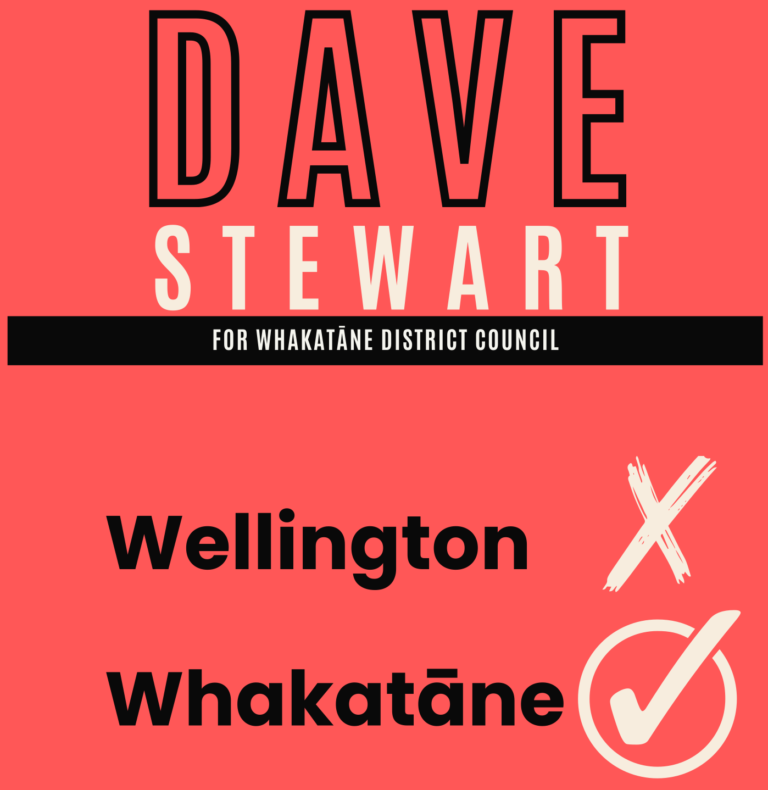
Don’t Vote For Wellington – Vote For Whakatāne

National’s hidden agenda was unaffordable rates. And now we are having to address it.

National’s supporters in this campaign here in Whakatāne are telling us to pay for National’s $440 million water alternatives we must sell our publicly owned assets and privatise everything that moves. This means we will pay the same of higher rates, and then pay again for the services our rates used to cover.

Continue Reading

Article: Councillors tired of being ‘beaten up’ and blamed by central government

In a statement yesterday, Local Government Minister Simon Watts said some households were getting frustrated by unfair rate hikes during the cost-of-living crisis.

It followed comments at the recent Local Government NZ (LGNZ) conference, where Watts compared councils to children and suggested that letting them do what they wanted might lead to bad choices.

Olds, who attended the conference, told his colleagues and LGNZ representatives that he was disappointed that councils continued to get “beaten up by central government” over things that were out of their control.

Councils had defended rising rates as they were dealing with increased infrastructure costs, unfunded mandates, insurance, and inflation.

LGNZ chief executive Susan Freeman-Greene said tensions between local and central government were “a challenge”, and that councils bore the impact of frequent changes to government policy.

Continue Reading

Article: The argument against council rate caps

OPINION: What do we do about 78 councils, rising rates and the need to improve efficiency and focus on the basics?

Some argue the Government should simply pass a law to cap rates and let ‘the market’ sort itself out. But history tells us blunt interventions often generate unintended consequences.

When councils have focused purely on rate minimisation in the past, they’ve generally cut infrastructure maintenance, inspections and deferred capital investment, contributing to a significant proportion of New Zealand’s $200 billion infrastructure deficit.

Government wants to grow the economy and speed up housing development. Yet, ironically, it needs councils to enable housing growth, through investments in roads, water, transport and other essential services.

Capping rates without addressing the funding model simply kneecaps councils’ ability to invest. Without money, projects don’t proceed and assets deteriorate.

Continue Reading
Article: Capping rates rises would make things ‘worse not better’ – Chris Hipkins

“Having created a situation where councils are being forced to put up the rates to pay for things like water infrastructure, the government’s now trying to blame them for doing something that they really don’t have a choice but to do.

“Ultimately if the government don’t want councils to increase rates, they’ve got to find another way of funding the water infrastructure that we need.”

Local Government New Zealand president and Selwyn District mayor Sam Broughton said rates capping could be “disastrous for communities” and leave councils without the means to fund essential infrastructure.

Continue Reading